I used to talk about burnout

This is the content of a talk I gave in Play by Play game development conference in 2021. At that moment I didn't have all the diagnoses nor the understanding of chronic illness I now possess, but the content now stands as foreshadowing of the events that lead me to create Tethered Sorrow.
Burnout and me
The (im)perfect talk you were searching for
Hi all! My name is Gaby. I am one of those random people on the internet. I am here talking to you today because I am an expert at burning out. I don’t know how but I became really good at burning out over the years. Not on purpose of course, burning out is rather unpleasant, but after the third time I started to wonder if there was some kind of lesson that I should be learning so that I didn’t have to go through the same thing again.
I went out looking for the answer, and … I can’t say that I found it, BUT maybe my journey will help you understand the problem a little bit better.
What is burnout?
So, what is burnout? I am not going to go into a lot of detail or give you a technical definition for it, (well, except for that one I already gave you). Scientists seem to have different interpretations of it and some even think that it doesn’t exist as a separate phenomenon from just plain old depression.
For most people it presents as a series of symptoms that make their life difficult and working quite unbearable. For me, those symptoms were just a part of it, the beginning if you will. For me burnout had much more extreme consequences.
My three burnouts
(up until then)
I was 22 when I burned out for the first time. One day I woke up in bed, I looked at the ceiling and I said to myself: “I can’t do it, I can’t go to work today. I can’t go to work anymore.” I walked to the post office and I sent my resignation letter that day. It was fairly painless, it was a very impersonal place to begin with and the conditions were terrible, no wonder I didn’t want to work there anymore.
The second time I burned out I was at the office. I stopped the work I was doing, I took the elevator downstairs, I sat on the sidewalk and started crying. I had to call my partner to pick me up. I was shaking. I could not even muster the energy to call my boss and tell them I was leaving for the day. They were understanding however, and told me to take a leave of absence, but it was too late. I knew in my core that I could not go back. I quit shortly after. This time it hit different: I loved the job, I well liked my colleagues and superiors, why couldn’t I just get over it?
The third time was the hardest of them all. I spent a good part of my adult life thinking that this was the one, this was the perfect job for me; and for a period of time it was. Many aspects of the work I really loved, so much so that I overlooked the fact that it was actually taking a toll on me. I already knew what being burned out felt like, I already knew the terrible consequences that it had, but I chose to fight for a bit longer in the name of my “dreams”. My dear audience, it did not work. Again, I had to take a leave of absence, but I could not come back, not even to pick up my things. For almost a year I could not even walk around the area where my old office building was.
Signs and symptoms
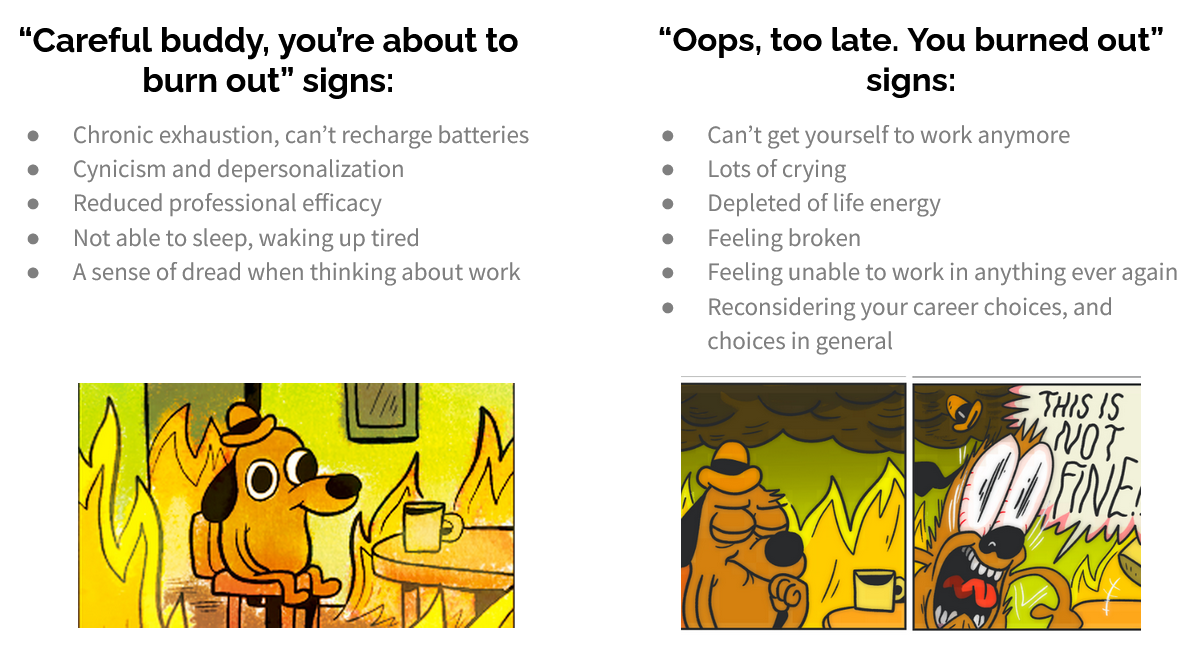
The way burnout manifested for me was with the complete impossibility to continue doing any kind of work. There were many other symptoms and tell-tale signs that I can now see thanks to the benefit of hindsight, but that was the breaking point I reached each of the three times. This situation was followed by an increasingly longer period of unemployment when I was incapacitated from doing any mentally challenging activity.
So, if you are in the first part of this slide, you dread going to work every day, you think that everything you do is pointless and even if you take a rest you don’t recover, you are burned out. It could be that this is all that will happen and that is just how burnout manifests for you. Or you could be like me, and have a second, much severe stage of burnout that could cost you many months of depression, side effects and chewing through your savings, before you are able to get back on track.
Be warned, and be afraid, because there are very real consequences for your body and your brain that you should take into account when you choose to continue in an environment that led you to burnout.
Physical symptoms and complications
Sometimes it’s not all in your head
I am not sure if you’ve heard of this before or if you’ve considered it, but burnout and chronic stress can have some very real consequences for your physical health as well as your mental health. Although you could say “duh, off course that stress can affect your body”, I am willing to bet that many people don’t consider going to their doctor when they’re feeling overwhelmed at work.
In my experience, my body starts sending me signs that something is not quite right well before I’m conscious that I’m not enjoying myself so much at work anymore. Things like back pain, difficulty sleeping, headaches, can be mild early-on symptoms that our body is under a considerable amount of stress.
Health complications related to burnout
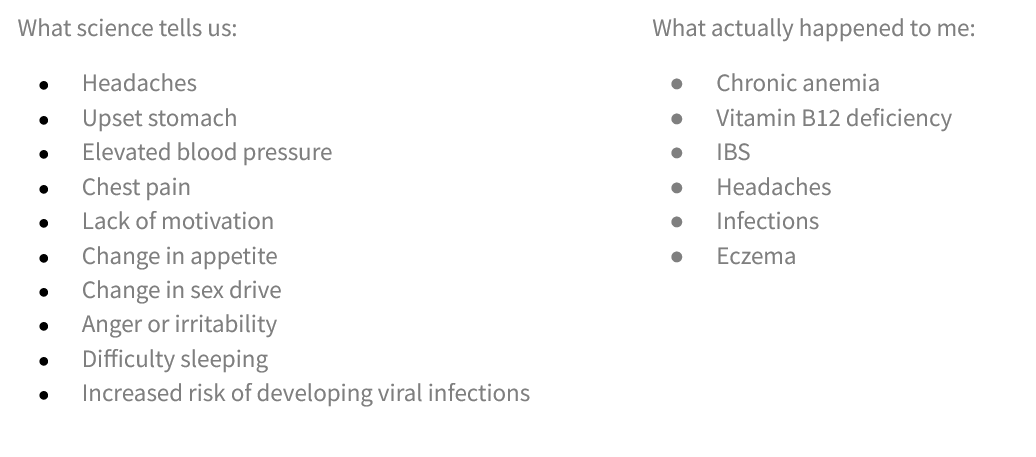
If we leave these things to develop for a long time, or we simply put down everything that we are feeling as “normal side effects of stress” without actually acting to fix them, we are risking more than we think we are.
As an example, after my experiences with burnout I now suffer chronic anaemia and vitamin b12 deficiency, which could progress into brain damage if I don’t get regular B12 injections. Folks, I cannot emphasize how much I do not want to get brain damage. It also becomes a self-fulfilling prophecy because I am so physically exhausted that I cannot work in my recovery.
Seek treatment for what you feel
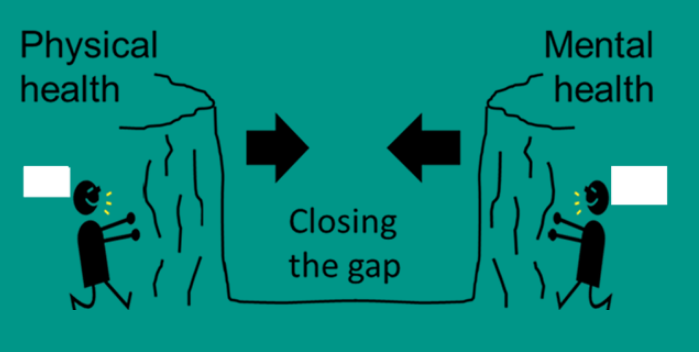
If you have to take just one thing out of the whole talk, please let it be this: seek treatment for your physical symptoms.
I understand the health system can be difficult to navigate, with longer wait times than what we prefer, or with some physicians disregarding your symptoms at first, but it is essential (and sometimes life saving) to treat issues before they become even bigger problems.
I would recommend you to look for psychotherapy as well, but unfortunately that’s something completely out of reach for most people due to the high cost and the fact that every therapist in the country (world) seems to be booked out. I’m sorry, that’s a bummer. You can try online sessions though, that worked for me.
Understanding why
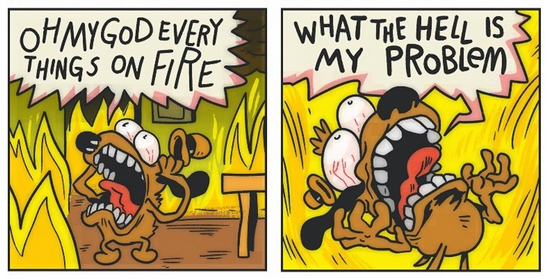
Ok, so: let’s say you’re lying on the couch, you know that you’re burned out, you sought treatment for what you can; you took that holiday, you meditated, you do the yoga classes… If you are anything like me what comes next is the existential crisis and looking for answers. Over the second part of my presentation I will try to explain what I found on my research as well as my own opinions as to what might be the cause of burnout.
The obvious culprits
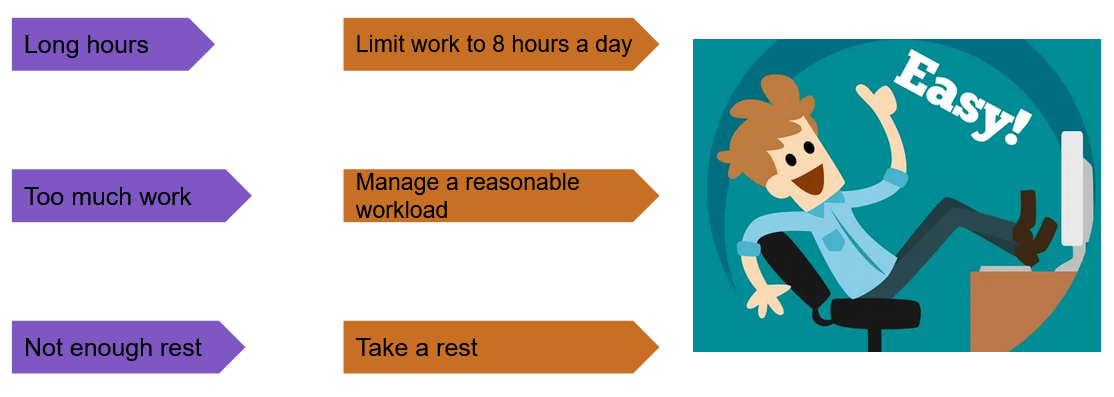
The first things that come up when you research ‘burnout causes and recovery’, are your standard ‘common-sense’ issues that people normally associate with the word “burnout”. These are long hours, not switching off after coming home, a big workload or not taking enough breaks. Although they could seem obvious, sometimes we do neglect to look at these issues before they become a bigger problem.
The advice to tackle this is: exercise, eat a balanced diet, sleep 8 hours at night, ask for help with the extra workload. Easy right?
I mean, no shade if this actually works for you, but to me this is completely inconsequential advice. I did try it every time, it didn’t work.
The individual vs organizational responsibility
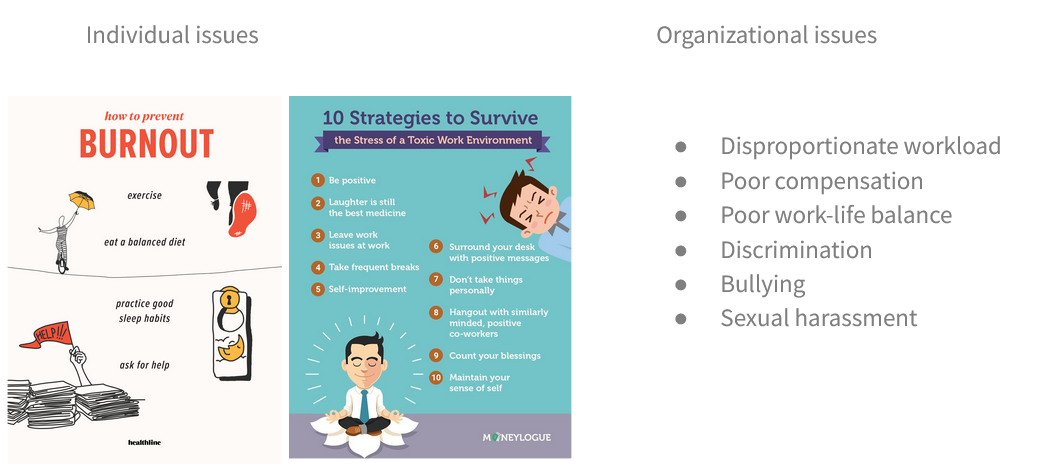
Looking a bit deeper into what the scientific community makes available surrounding the burnout problem, you can mostly see two perspectives on the matter.
On one side, -the individual as the beginning and end of the problem-: You can see this a lot in “self-help” or “health” gurus. The approach is taking personal actions to manage and recover from burnout, such as exercise, meditation, getting more rest, seeking psychotherapy. I take issue with this approach; I find it frustrating because it doesn’t account for a lot of things that are out of our control.
The other perspective is -the Organization bears the responsibility of burning out employees-: To find the cause you have to look at the company structure and culture and identify problems that contribute to the employees’ dissatisfaction and disconnect. You can look at implementing the basic stepping stones that make a workplace healthy and start from there; like tackle discrimination and bullying from example, and then move on to some of the less obvious problems. Again, sounds clear right? Only that it’s not.
In my experience, burnout was not only caused by your textbook “toxic workplace” and it didn’t affect everyone the same way.
Everything is more complex than it seems
So what do I mean by “everything is more complex than it seems”.
Let’s say the employer is trying their best to foster a healthy workplace, but the nature of the job means that you have to deal with a lot of angry customers who scrutinize everything you do and take any chance to make their discomfort known to you.
Or you as an employee love the job and you really want to do well, but because of unresolved childhood trauma you have a constant need to get external validation; all the while a fierce, aggressive, negative internal voice tells you that you suck and that you will never be good at anything.
Or suddenly a deadly disease spreads out all over the world and everybody in the company is now stuck at home for the foreseeable future while the economy crashes and social unrest grows…
Human experience is complicated
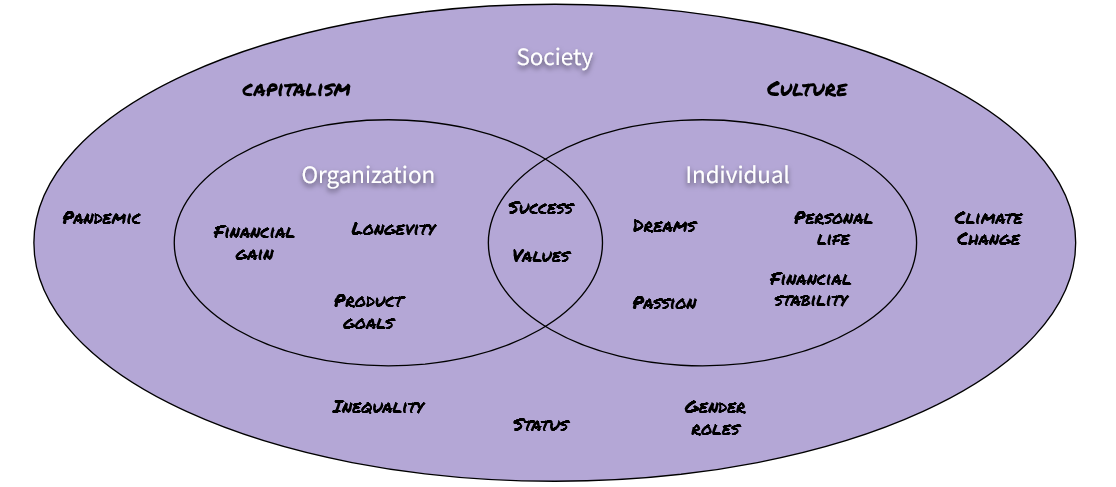
But which is the right answer? Whose fault is it?
The way I like to think about it is looking at everything as a system, where each element is connected and influences the other. It is not one single factor that is a fault, but an unfortunate combination of different ones.
Organizations and people do not exist in a vacuum, they are part of a bigger structure which influences both. This is not to say that Society is to blame for burnout, it’s more complex than that.
Each person comes with their own personality and goals, which is traversed by their upbringing and their culture. They work in an organization that is trying to fulfill their own goals and that is motivated by some different interests. They need each other in other to meet their objectives. There are external factors that will determine many things about this exchange. Of two different people working at the same place, one might burn out while the other doesn’t. Or a company with a good culture for many years may experience more people getting burned out if there is an external crisis.
I give you an example, imagine an employee… let’s call him “Timmy”. Timmy wants to work making video games because it aligns with his passion and dreams, and one day gets a job at a videogame company. Timmy gets paid 20% less doing the same work that he would get if he worked in another industry, but he doesn’t care because the job gives him fulfillment and status. The videogame company is OK with paying Timmy less because it is acceptable in the industry and allows them to offer cheaper games to players while getting more profit. One day Timmy starts a family and buys a house, and after a while the interest rates on his mortgage rises. He now needs more compensation for his work, but is unable to obtain it while working on the videogame industry. Despite this, he continues to work on games, but the strain it puts in his life grows over time and he burns out. Is this Timmy’s fault for sticking to a job that he likes even when it doesn’t pay the bills? Is it the videogame company’s fault for not paying him what he would get somewhere else? Is it the economic crisis or the government that makes interests rates unaffordable?
It is not one in particular but the result of the combination of these circumstances that leads to burnout in my opinion.
But, now what?
I know what you are thinking, what do we do now with this information? We can’t fix all the problems at once, can we?
I understand it is not very satisfactory, and perhaps rather unhelpful, to say “things are complicated” and leave it at that. It certainly doesn’t feel right for me because so many of these issues I mentioned are out of our control.
I bet this is the moment in the talk when you expect me to give you helpful advice, or perhaps a big revelation that will bring everything together. Maybe give you an inspirational phrase…
Ok, I’ll try.
If you are an organization out there, or have any sort of power in a company: consider that perhaps your employees are not just resources; they are complex human beings, with needs and lives that transcend who they are in the workplace. It might seem like hard work to try and keep them happy, but you will be saving yourself the trouble of having to find and re-train people all the time.
And for you, the person, the close to/already burned out worker, I tell you this: hang in there. The perfect career, the perfect job might not exist, but life can still be beautiful. Look inside and find out what is important to you so that you can find a place that aligns with it. I believe in you.
References and extra stuff
https://github.com/gabrielamelian/burnout-resources
If you rather watch the video version here it is